
Homeostasis 2
[mcq id=”5322″ ]
Homeostasis
[mcq id=”5318″ ]
Sclerides
Sclereids typically are short cells with thick secondary walls, strongly lignified, and provided with numerous simple pits. Some sclereids have relatively thin secondary walls, however, and may be difficult to distinguish from sclerified parenchyma cells. The thick-walled forms, on the other hand, may strongly contrast with parenchyma cells: their walls may be so massive as almost to occlude the lumina, and […]
Fibers
Fibers typically are long, spindle-shaped cells, with more or less thick secondary walls, and they usually occur in strands. Such strands constitute the “fibers” of commerce. The process of retting (technical form of the word rotting) used in the extraction of fibers from the plant results in a separation of the fiber bundles from the associated nonfibrous cells. Within a strand, the […]
Sclerenchyma
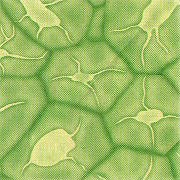
The term sclerenchyma refers to a tissue composed of cells with secondary walls, often lignifi ed, whose principal function is mechanical or support. These cells are supposed to enable plant organs to withstand various strains, such as may result from stretching, bending, weight, and pressure without undue damage to the thinwalled softer cells. The word is derived from the Greek skleros, meaning […]
Parenchyma
The term parenchyma refers to a tissue composed of living cells variable in their morphology and physiology, but generally having thin walls and a polyhedral shape, and concerned with vegetative activities of the plant. The individual cells of such a tissue are parenchyma cells. The word parenchyma is derived from the Greek para, beside, and en-chein, to pour, a combination of […]
Cell Wall- Chemical Composition
MACROMOLECULAR COMPONENTS OF THE CELL WALL Cellulose Is the Principal Component of Plant Cell Walls The principal component of plant cell walls is cellulose, a polysaccharide with the empirical formula (C6H10O5)n. Its molecules are linear chains of (1→4)β-linked-D-glucan (repeating monomers of glucose attached end to end). These long, thin cellulose molecules tend to hydrogen bond together to form microfibrils. Considerable variation […]
Cell Wall
The presence of a cell wall, above all other characteristics, distinguishes plant cells from animal cells. Its presence is the basis of many of the characteristics of plants as organisms. The cell wall is rigid and therefore limits the size of the protoplast, preventing rupture of the plasma membrane when the protoplast enlarges following the uptake […]
Sources and Sinks
Sources include any exporting organs, typically mature leaves, that are capable of producing photosynthate in excess of their own needs. The term photosynthate refers to products of photosynthesis. Another type of source is a storage organ during the exporting phase of its development. For example, the storage root of the biennial wild beet (Beta maritima) […]
PATHWAYS OF TRANSLOCATION
The two long-distance transport pathways—the phloem and the xylem—extend throughout the plant body. The phloem is generally found on the outer side of both primary and secondary vascular tissues. In plants with secondary growth the phloem constitutes the inner bark. The cells of the phloem that conduct sugars and other organic materials throughout the plant are […]